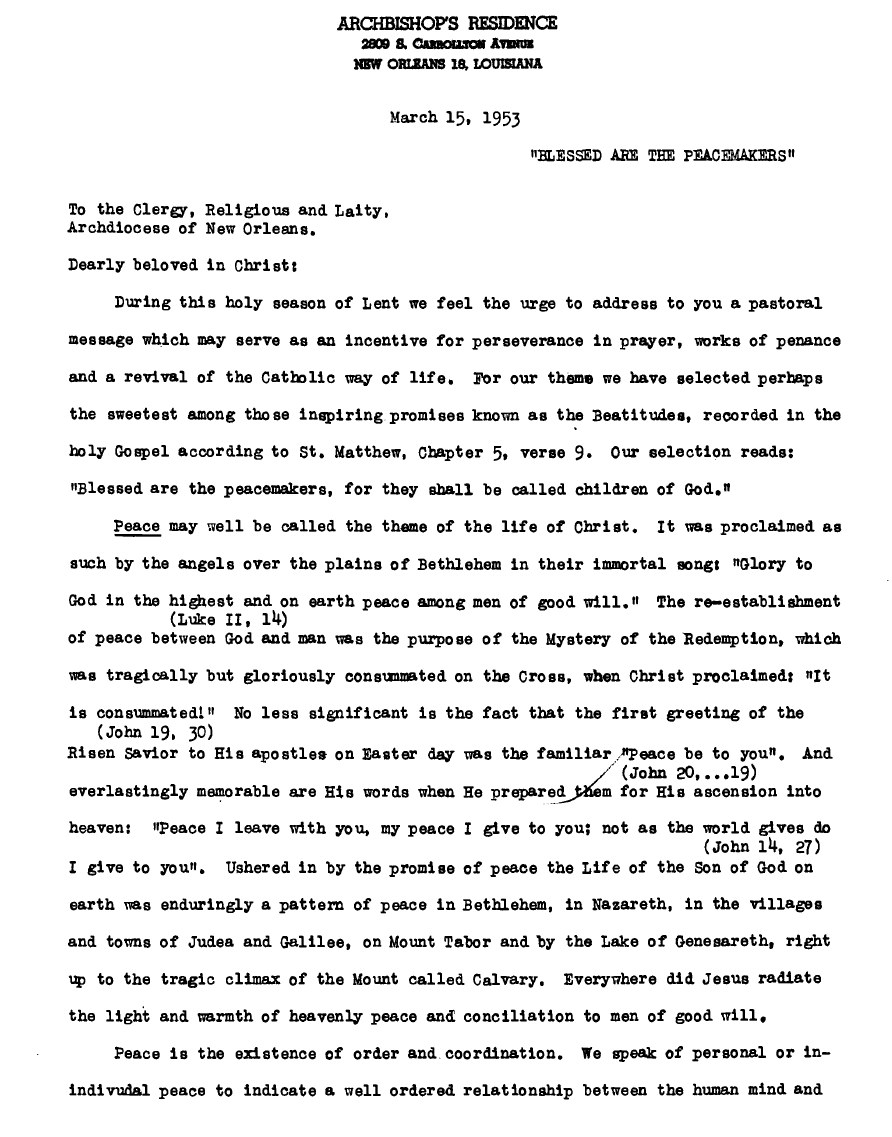
ARCHBISHOP’S RESIDENCE
2809 S. Carrollton Avenue
New Orleans 18, Louisiana
March 15, 1953
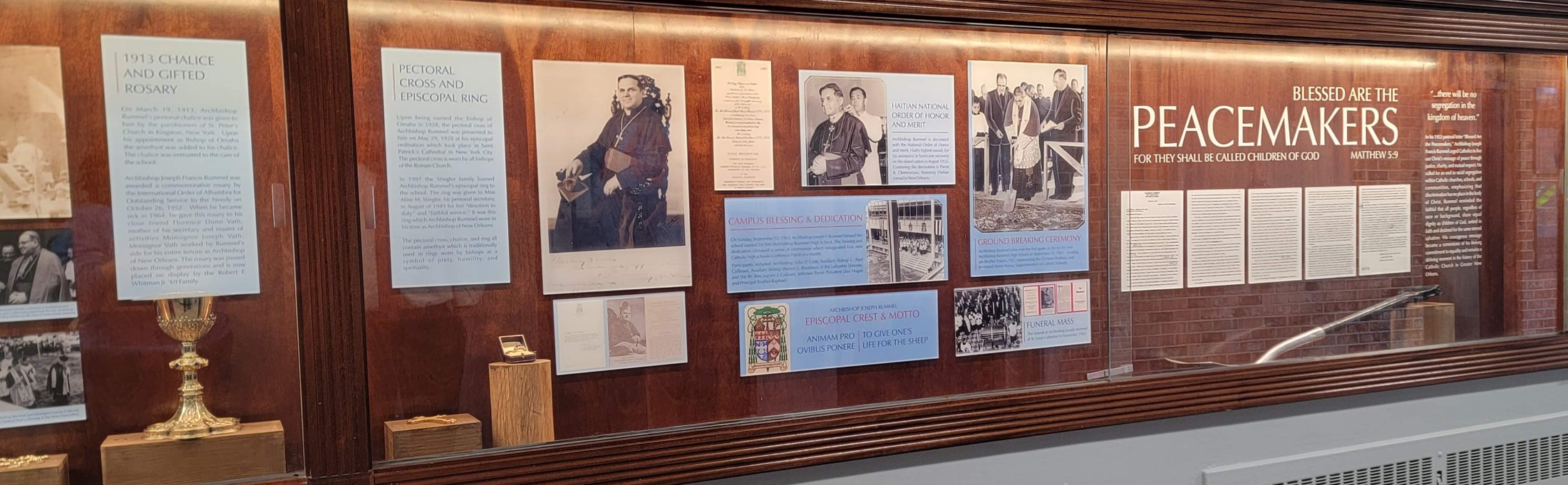
“BLESSED ARE THE PEACEMAKERS”
To the Clergy, Religious and Laity, Archdiocese of New Orleans.
Dearly beloved in Christ:
During this holy season of Lent we feel the urge to address to you a pastoral message which may serve as an incentive for perseverance in prayer, works of penance and a revival of the Catholic way of life. For our theme we have selected perhaps the sweetest among those inspiring promises known as the Beatitudes, recorded in the holy Gospel according to St. Matthew, Chapter 5, verse 9. Our selection reads: “Blessed are the peacemakers, for they shall be called children of God.”
Peace may well be called the theme of the life of Christ. It is proclaimed as such by the angels over the plains of Bethlehem in their immortal song, “Glory to God in the highest and on earth peace among men of good will.” The re-establishment of peace between God and man is the purpose of the Mystery of the Redemption, which was tragically but gloriously consummated on the Cross, when Christ proclaimed, “It is consummated!”
No less significant is the fact that the first greeting of the Risen Savior to His apostles on Easter day was the familiar “Peace be to you.” And everlastingly memorable are His words when He prepared them for His ascension into heaven: “Peace I leave with you, my peace I give to you; not as the world gives do I give to you.”
Ushered in by the promise of peace, the life of the Son of God on earth was enduringly a pattern of peace in Bethlehem, in Nazareth, in the villages and towns of Judea and Galilee, on Mount Tabor and by the Lake of Genesareth, right up to the tragic climax of the Mount called Calvary. Everywhere did Jesus radiate the light and warmth of heavenly peace and conciliation to men of good will.
Peace is the existence of order and coordination. We speak of personal or individual peace to indicate a well ordered relationship between the human mind and
the human will and the control which both mind and will exercise over the senses of the body, the emotions of the heart and the passions of the soul. When this coordination is inspired and regulated by principles which are in conformity with the natural law and the will of God, it establishes a tranquillity of soul, which in turn is known as peace of conscience or interior peace. It should be the aspiration of every human soul to acquire this personal internal peace, for in it and through it alone can we experience genuine happiness and contentment.
The order or coordination of habits and interests between human individuals and groups of individuals in their various relationships, results in social peace. Here the elements of justice and charity are the principal sources from which social peace derives inspiration and direction. As personal or interior peace guarantees happiness and contentment to the individual soul, thus social peace is the pledge of happiness, security and prosperity to society at large.
The establishment of order between nations and governments according to principles of justice, inalienable human rights, historic traditions and the immutable laws of God may be said to constitute international peace.
In the halcyon days of the millennium, when all nations will accept with mutual sincerity such order and coordination, then will the world experience the freedom, the happiness and the prosperity for which human hearts in every corner of God’s earth long, and pray and sigh as the foretaste of heaven.
It is characteristic of every type of peace that it is not achieved without sacrifice. No individual finds true peace within himself until he has learned to curb his passions, control his emotions, guard his senses, restrain his imagination, bring his mind under the subjection of his will and make his will a perfect instrument of the all holy and adorable will of the Eternal God. All this involves not one but many sacrifices, which are possible only through full cooperation with divine grace, that heavenly gift which “enlightens the mind and strengthens the will to shun evil and do good.”
Nor is peace achieved without sacrifice between individuals, between the members
of the family, between larger groups of human society and between nations. In every instance there is need of self restraint, self-control, a balanced recognition of mutual rights and duties and not infrequently the surrender and exchange of certain rights and obligations for the common good. It is this element of sacrifice which makes the attainment and maintenance of peace so difficult and so frequently causes peacemaking efforts to end in frustration and failure. Peace between groups and between nations is the result of a delicate application and adjustment of the principles of justice and of charity.
This adjustment and application not infrequently requires the intervention of a third or disinterested party, and thus we have the office of peacemaker. When our Divine Savior called peacemakers “blessed,” He undoubtedly had in mind not only the priceless gift of peace of which they become the instruments, but also the merit that is due to those whose wisdom, truth and influence bring to recognition the virtues of justice and charity, which are the foundations of true peace. Our Divine Savior Himself set a glorious example of the spirit of sacrifice which must characterize the role of a genuine peacemaker, when He carried the Cross through the streets of Jerusalem and sacrificed His life upon the Hill of Calvary. Thus He sealed with His own Precious Blood the bond of peace between the outraged Majesty of God and sinful man.
Christ came into this sinful world to be not only the herald of peace but also the Divine Peacemaker: “For it has pleased God the Father that in Him all His fullness should dwell, and that through Him He should reconcile to Himself all things, whether on the earth or in the heaven, making peace through the Blood of the Cross.”
We are not all called upon to be peacemakers in the same sense or degree, but certainly it must be the ambition and longing of all without exception to establish and maintain true inward peace by conforming perfectly our minds, our hearts and our wills with the eternal, all holy Will of God, thus patterning our lives after the life of Christ. On no other basis can we share the peace promised at the birth of the Savior to men of “good will.”
All of us certainly have the obligation of being peacemakers by cultivating
relations of genuine charity and good will with the members of our own household and family to the exclusion of anger, meanness, quarreling, abusive words and actions and all hardness of heart. “This is the haven of peace” may well be inscribed as a motto over the door of every home, especially the home that is dedicated to the Catholic way of life.
We can and should likewise function as peacemakers by living up to and promoting the principles of justice and charity in the office, in the shop, in the store, in the factory, in meeting places and wherever we come in contact with our fellowmen. Kindness, courtesy and a helping hand contribute much towards social peace, mutual understanding and happiness.
And now we call upon all the members of our beloved flock to exercise the role of peacemakers in our intercourse with those who may differ from us by characteristics of race, nationality, color of the skin, habits or creed. In all we must respect the common bond that stems from the fatherhood of God and the brotherhood of men. We are all created to the image and likeness of God, endowed with a spiritual nature and called to participate in the eternal happiness of heaven. All were envisioned in the mysteries of the Incarnation and the Redemption; all are invited to participate in the merits of Christ’s death upon the Cross and in the graces which that sacrifice made available. The obligations of justice and of Christ’s mandate of charity: “Love thy neighbor as thyself” provide for no exceptions on the lines indicated; nor does His mission to the Apostles, “Go, make disciples of all nations,” suggest any discrimination.
In particular we are here concerned about our attitude towards our brethren of the Colored race. Much is today being spoken and written about the so-called problem of segregation as reflected in certain laws, agreements and customs. Undoubtedly the Federal and State Courts, supported by wholesome public opinion, will in due time define where such laws and customs are in conflict with the American Constitution and way of life, but we can help hasten the day of complete peaceful adjustment by an ever increasing spirit, in word and action, of good will, respect and sympathy towards the Colored people. Public laws, customs of long standing, regulations and agreements of institutions and between business interests are obstacles not easy to overcome, but we can do much to aid this cause of justice and charity by making segregation disappear in our Catholic church life. We have already made notable progress by the removal of offensive signs that limited the use of certain pews and by the aggregation of Colored units with the Metropolitan, Deanery and Diocesan Unions of the Holy Name
Society, the Sodality and the Councils of Catholic Men and Women. But there still persists in some churches the practice of expecting the Colored to occupy a certain section of pews and to wait at the end of the line for Holy Communion. There may be other practices that cause humiliation and embarrassment, which should be foreign to our religious life and considered unworthy of a true spiritual understanding of our Catholic faith.
Ever mindful, therefore, of the basic truth that our Colored Catholic brethren share with us the same spiritual life and destiny, the same membership in the Mystical Body of Christ, the same dependence upon the Word of God, the participation in the Sacraments, especially the Most Holy Eucharist, the same need of moral and social encouragement, let there be no further discrimination or segregation in the pews, at the Communion rail, at the confessional and in parish meetings, just as there will be no segregation in the kingdom of heaven. Our Colored Catholics are encouraged and urged to retain their loyalty and membership in their special congregations, but they should not be harassed when they attend services in any parish church or mission, or when they apply for membership in parish organizations. These observances will contribute much to the edification of all who are genuinely interested in our holy Catholic faith and guarantee to all of us a greater participation in the promise of Christ when He proclaimed from the Mountain of the Beatitudes: “Blessed are the peacemakers, for they shall be called children of God.”
As for peace on the worldwide basis between the nations, we can only contribute the benefit of our united prayers in union with the never ending efforts of the Vicar of Christ, Pope Pius XII, whom we commend very especially to your prayerful remembrances as he enters upon the 15th year of his pontificate. May our Divine Savior spare him to the Church and the world for years to come and may all of us merit the blessedness of peacemakers and children of God.
Faithfully yours in the Prince of Peace,
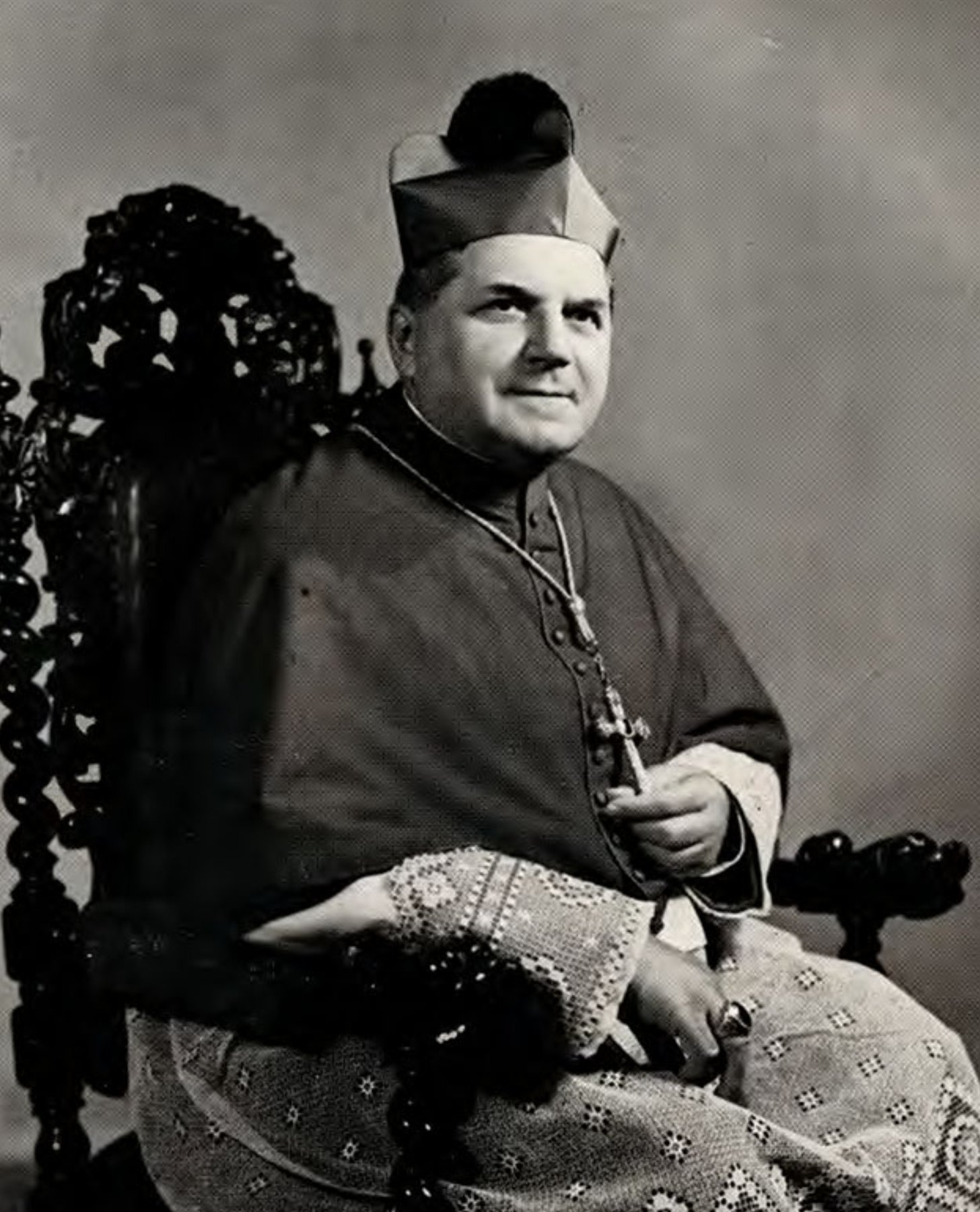
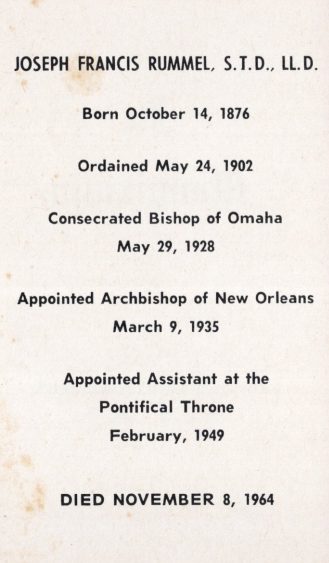
+ JOSEPH FRANCIS RUMMEL
Archbishop of New Orleans.
Laetare Sunday
March 15, 1953