It started with a sheriff and a microphone.
June 1, 1955. At the dedication of a women’s retreat house in Metairie, Jefferson Parish Sheriff Frank Clancy stepped away from the program, faced the Archbishop, and said what the whole parish had been thinking.
Your Excellency, I wish to say publicly that the time is overdue for us in Jefferson to have our own Catholic high schools for boys and girls. The City of New Orleans has twenty two such schools; we have none in this civil parish even though our population, especially in Metairie, has been booming. Please be sure to think of us when you plan new high schools.
Sheriff, I have already discussed with other officials the possible construction of Catholic high schools in the not too distant future.
The exchange was in the next morning’s newspaper, and the Archbishop kept his word. He named a committee to find sites for four secondary schools, two on each bank of the river. The committee noticed that Interstate 10 was coming, that Causeway Boulevard and Severn Avenue would become the arteries of the parish, and pointed at the Shrewsbury section of Metairie for the boys’ school.
They recommended six lots known as the Hyland Plantation, pasture land fenced for cattle grazing, for $200,000. The act of sale was signed on August 25, 1960, the feast of St. Louis, King of France, patron of the Archdiocese.
The Archbishop wanted the first invitation to staff the school to go to the Christian Brothers. Every Provincial Superior was in Rome, so Msgr. Bezou placed a transatlantic call and made the case in French to the Superior General, Brother Nicet Joseph, FSC. After prayer and consultation, the Brothers said yes.
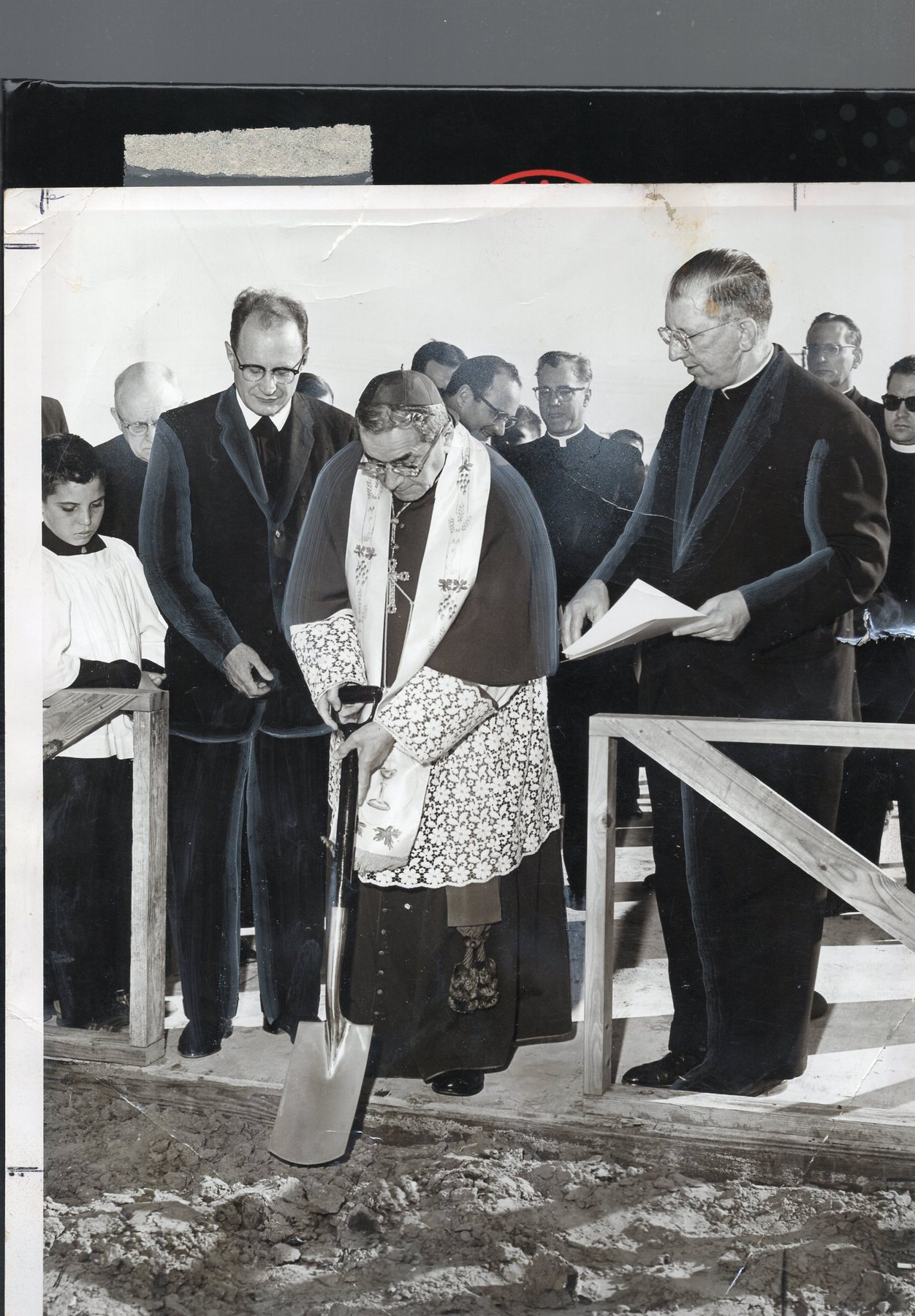
Nolan, Norman, and Nolan drew the plans in the spring of 1961. Southern Builders, Inc. won the bid at $922,250 for the residence, the offices, the library, the cafeteria, the chapel, and the classrooms. In September 1961 the Archbishop dug the first spade of dirt himself.
Three names on the table. He objected to the one that won.
Up to the groundbreaking, every legal document called it the Catholic High School for Boys. The Archbishop thought naming a school for a living man was inappropriate. It took the whole school board, clerical and lay, to change his mind.
Catholic High School for Boys
The working title on every architect’s and contractor’s document until the ground was broken.
Shrewsbury Catholic Boys’ High School
For the neighborhood, and for the English town of Shrewsbury, which sits inside a bend of the River Severn.
Archbishop Joseph Francis Rummel High School
All four new schools would carry the names of twentieth century archbishops. He had lived past three score and ten and done more for education than all his predecessors combined. After much protestation, he relented.
His fellow priests warned him what the sports pages would print once the school had teams: Rummel Trounces, Rummel Slays the Blue Jays. Msgr. Bezou wrote that the Archbishop took the jests with a chuckle.
September 1962. Everything had to be invented.
A brand new school of nothing but freshmen has no colors, no nickname, no traditions, and no uniforms. Brother John Fairfax, FSC, the founding assistant principal, remembered one thing above all: sand. Truckload after truckload of river sand to raise the ground three feet, and on a windy day it covered every desk. Five Christian Brothers and four laymen taught. Then the boys got to work.
The colors, November 1962
Chosen by a vote of the student body from five slates the boys had put up in October.
The name
It beat the Gladiators, the Dragons, the Lancers, and the Griffins. Four years later the mascot was named Rufus for senior Rufus Cressend ’66, and Brother Ephrem, FSC, the principal, commissioned John Chase, the newspaper’s editorial cartoonist, to draw him. His horse got a name in 1979: Rumpus, from junior Paul Joseph ’80, because a rumpus is a loud disturbance, like a Rummel pep rally.
The newspaper
Brother John called together the boys who liked to write. Ronald Frentz ’66 suggested the name, and it has not changed since. Still printed, still student run.
The Fight Song
Borrowed from the 1960 Broadway musical Wildcat, starring Lucille Ball. Coleman Hardin ’66 wrote a few lines and Brother Fidelis, FSC finished them. “Way before LSU did,” Brother John liked to note.
Words and music
Written by Professor Howard Voorhies, the school’s first band director, in the first year, and sung at the end of everything since.
Tuition, for the year
“Not a month,” Brother John said. “$200 for the whole year.” Four clubs formed that first fall: the Benilde Club, the Debate Team, the Journalism Club, and the Altar Boys. An unofficial fifth, the Beautification Club, planted shrubs with the help of detention students.
From the display case. Touch to open.
The case in the main building holds the paper the first years left behind. Every object here is a scan of the real thing.
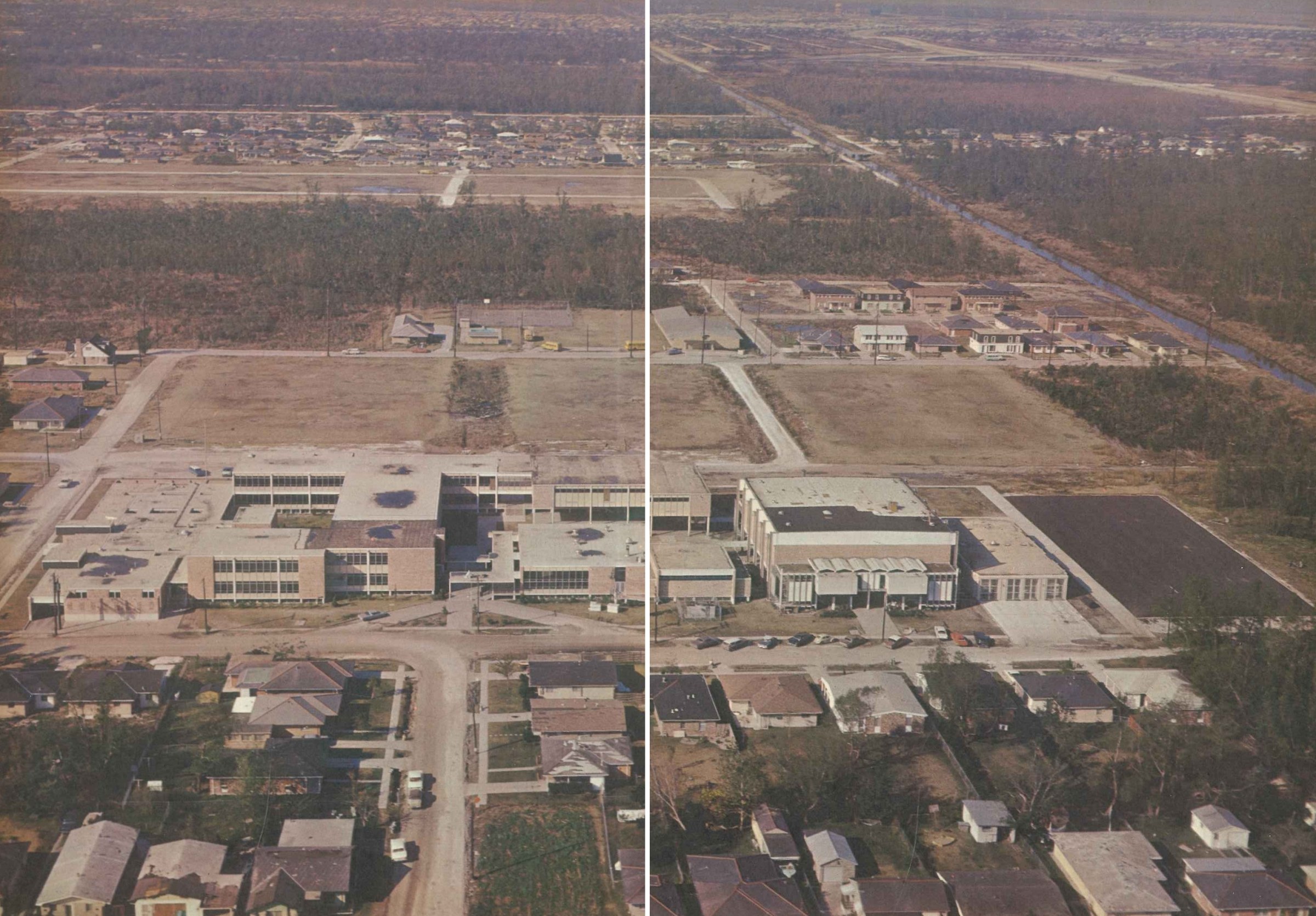
The campus, one purchase at a time.
A pasture became a school, and the school kept reaching across the street.
The doors open.
The Christian Brothers open the school on Severn Avenue. Two meetings for prospective families that spring, at St. Catherine of Siena and at St. Agnes, drew packed houses.
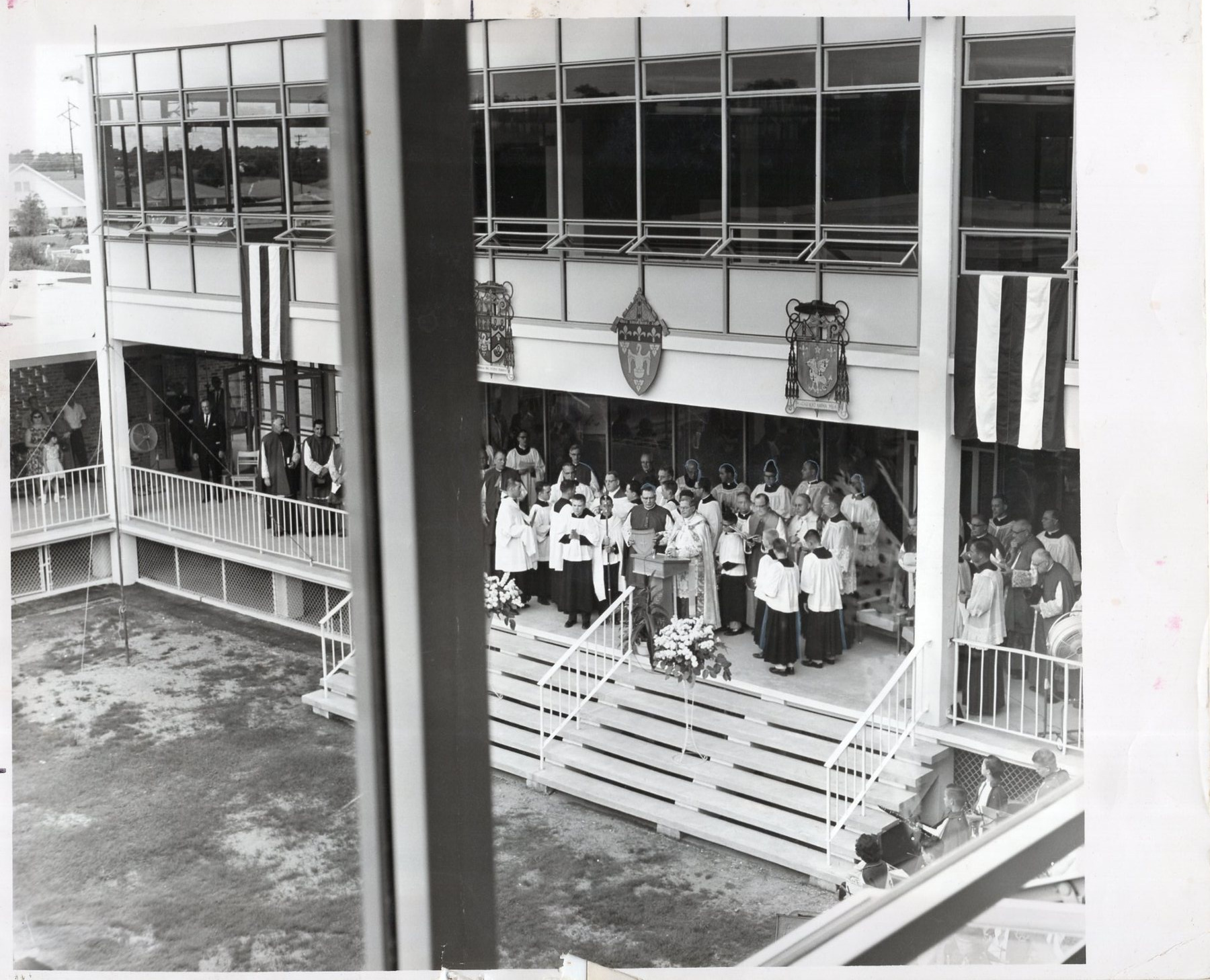
The gym is dedicated.
Given by the Nelson-Smythe family of Chicago while the first buildings were still going up, and approved at $441,126.30. On Sundays it became the first church of the new parish of Blessed, later Saint, Benilde. On April 30 the first Student Council was elected: Thomas Boudreaux, president.
The charter class graduates.
The Raiders take their name from Rufus Cressend ’66, the newspaper from Ronald Frentz ’66, the Fight Song from Coleman Hardin ’66. The class that invented the school walks out of it.
Across Severn Avenue.
Two large wooded lots on both sides of Severn, facing West Napoleon, for $200,000. They became the band practice field and the outfield of the baseball diamond.
The first Honorary Diploma.
Awarded at graduation to Brother John Fairfax, FSC, while he was still principal. He had been there since the sand.
Stuart Prep.
The Archdiocese approves the purchase of the Stuart Prep School for $1,050,000. It becomes the campus of the junior high.
Twenty five years.
Msgr. Bezou rededicates the school on September 10 and unveils a plaque in the administrative wing. On November 8, the anniversary of the Archbishop’s death, a Requiem Mass in St. Louis Cathedral, and a reception at Le Petit Théâtre. In February 1987, one Mass for all four archbishops’ schools at the Lakefront Arena.
“Come back in ten years.”
Brother John addresses the school at a Mass in the gym. “In forty years, things have changed and things haven’t changed. If you want to hear the rest of the story, come back in ten years for the fiftieth.”
Rededicated by Archbishop Aymond.
September 9, 2012: a Mass in the gym, a second plaque in the administrative wing. In November, a Mass at St. Louis Cathedral with the school’s alumni priests, shared with Archbishop Chapelle, and a walk to Muriel’s on Jackson Square. On May 17, Brother John kept his promise and told the rest of the story.
The Good Shepherd.
A statue of the Good Shepherd, the Archbishop’s own motto in bronze, is dedicated by Archbishop Aymond in front of the Rummel sign on the gym, with a raised garden and a new walkway: a new front door for the school.
The Rosary and Prayer Garden.
Built by alumni for Brother John Fairfax and dedicated by Archbishop Emeritus Aymond and Head of School Matthew Caire at the opening of the school year. The story keeps going. See the garden.
The man the school is named for has his own page.
Joseph Francis Rummel: born on the Rhine, ordained in Rome, laid to rest in St. Louis Cathedral, and the reason the sports pages got to print Rummel Trounces.